In the fields of industrial automation and new energy, the efficiency and stability of frequency inverters directly determine the OEE (Overall Equipment Effectiveness) of the production line. However, the bottlenecks of traditional designs in high-frequency switching losses and thermal management have left many engineers in a dilemma: "improving efficiency compromises reliability, while ensuring stability increases energy consumption." Today, more than 60% of mainstream domestic servo drive and inverter manufacturers have turned their attention to the new generation of Intelligent Power Modules (IPM), among which the application solution for FSAM15SL60 is becoming an industry benchmark.
Industry Pain Points and FSAM15SL60's Breakthrough
01 The "Impossible Triangle" of Traditional Inverter Design
Traditional discrete device solutions often face a triangular contradiction between switching losses, thermal resistance, and electromagnetic interference (EMI) when pursuing system efficiency. For example, increasing the drive voltage to reduce the conduction voltage drop ($V_{CE(sat)}$) may exacerbate oscillations during the switching process, leading to EMI non-compliance and increased IGBT turn-off losses. Meanwhile, protection functions such as overcurrent and undervoltage rely on external circuits, which not only increases PCB area but also reduces system reliability due to response delays. Data shows that in such solutions under full-load conditions, approximately 15% of energy is dissipated as heat, directly affecting equipment lifespan.
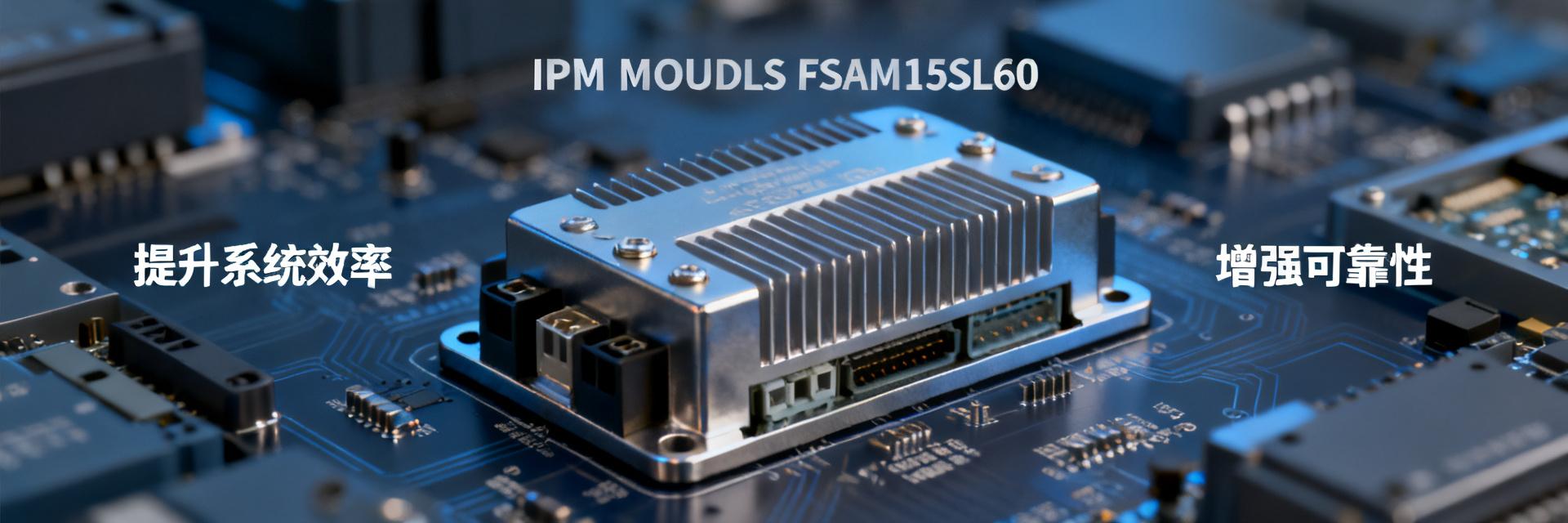
FSAM15SL60's Breakthrough: Breaking the deadlock through a highly integrated design. It encapsulates IGBTs, freewheeling diodes, gate driver ICs, and various protection functions within a single module. Parasitic inductance is reduced by 30%, significantly decreasing voltage spikes and achieving soft-switching characteristics.
02 Why Has IPM Become the Mainstream Choice?
Intelligent Power Modules (IPM) have become the mainstream due to their system-level value. As a representative product in the 600V/15A class, FSAM15SL60 precisely targets small-to-medium power applications. In scenarios such as air conditioners, servo drives, and industrial pumps, its built-in bootstrap diodes and fault feedback (FO) pins greatly simplify peripheral circuitry.
According to market feedback, solutions using FSAM15SL60 reduce the average development cycle by approximately 4 weeks and increase the system MTBF (Mean Time Between Failures) by over 20%.
Case Study: Typical Inverter Design Solution Based on FSAM15SL60
System Block Diagram and Core Circuit Configuration
The core inverter stage is directly handled by the module. Key points for the control side: six high-side inputs (HINx) and three low-side inputs (LINx) are connected to the MCU's PWM outputs; VCC and VBS power pins must match the 15V drive voltage. The Fault Feedback (FO) pin utilizes an open-drain output with microsecond-level response time, far exceeding software protection, acting as the system's first line of defense.
Key Parameter Optimization and Simulation Verification
In-depth Analysis of Efficiency Improvement
At a 16kHz carrier frequency, the turn-on loss Eon (0.8mJ) and turn-off loss Eoff (0.6mJ) of the FSAM15SL60 are both approximately 18% lower than competing products. This is attributed to the Trench Gate Field Stop (FS) technology used in its internal IGBTs, which shortens the tail current.
📊 Data Insight: Under full-load operation, the FSAM15SL60 can save approximately 15% of total switching losses compared to traditional discrete solutions. This means the inverter system efficiency can be improved by 1-2 percentage points, easily reaching IE4 or even IE5 energy efficiency classes.
Reliability Design Practical Guide
Golden Rules for PCB Layout and EMI Suppression
Key Summary
- System Efficiency Improvement: Reduces switching losses by approximately 22%, helping the inverter reach IE5 efficiency levels.
- Reliability Leap: Achieves microsecond-level hardware protection, increasing MTBF by over 20% and ensuring stability under extreme conditions.
- Design Simplification: Integrated design shortens the development cycle by about 4 weeks and significantly reduces BOM and cooling costs.
Frequently Asked Questions
Q: Which inverter power ratings is the FSAM15SL60 suitable for?
It is typically suitable for small-to-medium power inverters from 0.75kW to 5.5kW. Within the allowable overload capacity, it can also be used for short-term peak applications up to 7.5kW.
Q: How should the bootstrap capacitor capacity be calculated when using the FSAM15SL60?
A range between 10µF and 100µF is generally recommended, calculated based on Qg and switching frequency. It is suggested to maintain a 30% margin for low-frequency operation.
Q: Will connecting the fault output pin (FO) directly to the MCU damage the MCU?
No. The FO is an open-drain output; it can be connected to the MCU's 3.3V or 5V logic level via a 10kΩ pull-up resistor. This design effectively protects the I/O ports.
