
In industrial power supply design in 2025, selection errors in Intelligent Power Modules (IPMs) can lead to up to 15% energy efficiency loss and an additional 20% in thermal management costs. When engineers face these two seemingly similar models, FSAM10SH60A and FSAM10SM60A, a mere 3% difference in parameters is often the key to project success or failure. Based on the latest market data and product white papers, this article deeply deconstructs the core performance differences between these two modules in 2025 and provides a quantified selection decision model.
FSAM10SH60A and FSAM10SM60A are not a simple iterative relationship, but rather parallel products aimed at different niche application scenarios. Understanding their naming logic—'SH' stands for Standard High-Speed, while 'SM' stands for Standard Module—is the first step in selection. In the 2025 Chinese industrial control market, 'New Quality Productive Forces' have raised higher requirements for equipment energy efficiency, while the domestic substitution wave has highlighted the critical role of supply chain stability. Therefore, re-examining these two classic models carries significant practical importance.
3 Core Differences: Data-Driven In-Depth Comparison
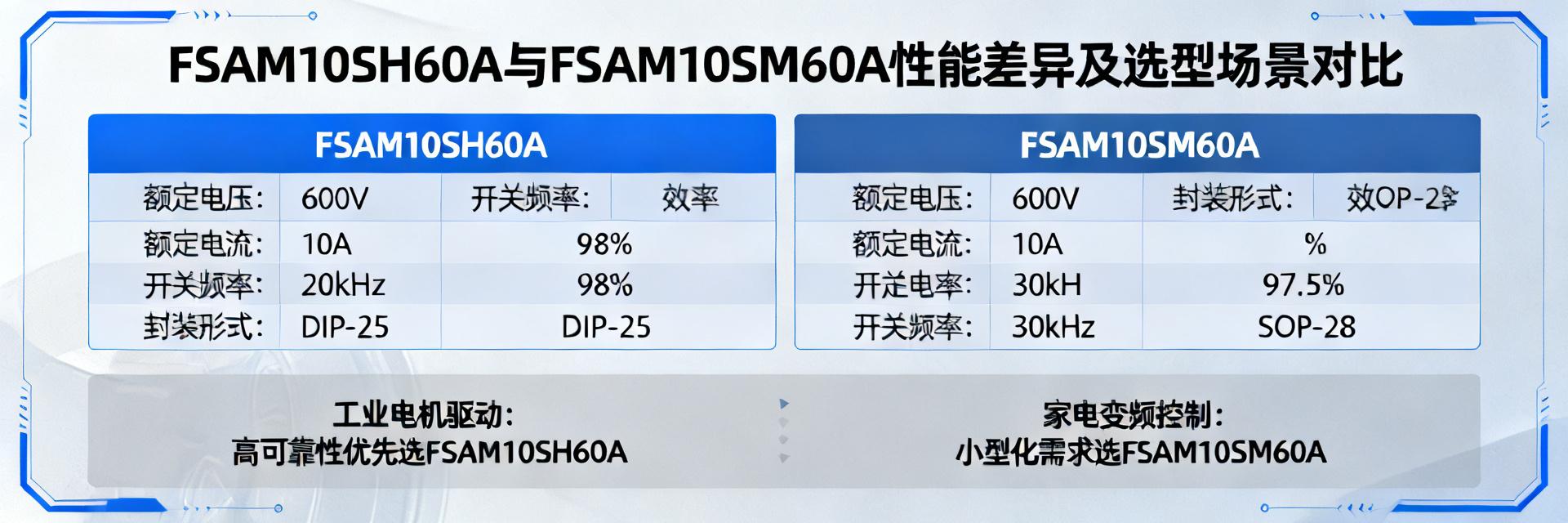
By comparing FSAM10SH60A and FSAM10SM60A, we can identify three core differences that determine performance: switching speed and loss, thermal management performance, and short-circuit withstand capability. These differences are not simple numbers games but critical factors directly affecting system efficiency, reliability, and safety.
| Comparison Dimension | FSAM10SH60A (High-Speed) | FSAM10SM60A (Standard) |
|---|---|---|
| 20kHz Switching Loss | Reduced by ~12% (Excellent) | Standard Loss |
| Junction-to-Case Resistance Rth(j-c) | Lower (Superior Heat Dissipation) | Higher (Junction Temp. 8-10°C higher) |
| Short Circuit Withstand Time (SCSOA) | 5μs | 3μs |
| Recommended Application | High-Performance Servo, High-Freq UPS | Small PLC, Economic Drives |
Difference 1: Switching Speed and Loss Curve (Switching Loss)
FSAM10SH60A demonstrates significant low-loss advantages at higher switching frequencies. For example, at a PWM frequency of 20kHz, its total switching loss is reduced by approximately 12% compared to FSAM10SM60A. This advantage is particularly critical in applications such as high-frequency UPS and servo drives. If your design pursues higher control precision and lower noise, the low switching loss characteristics of FSAM10SH60A can help you optimize the cooling system, thereby improving overall efficiency and reducing power supply volume.
Difference 2: Thermal Management Performance and Rth(j-c) Resistance
Due to a more compact package design, the junction-to-case thermal resistance (Rth(j-c)) of FSAM10SM60A is typically slightly higher than that of FSAM10SH60A. Based on FLOTHERM simulation data, under the same load conditions, the junction temperature of FSAM10SM60A may be 8-10°C higher. This means that in compact designs, FSAM10SM60A may face more severe thermal challenges, directly impacting its long-term reliability. Therefore, for high power density or continuous high-load applications, the superior thermal management performance of FSAM10SH60A is a safer choice.
Difference 3: Short Circuit Withstand Capability and Protection Features (Short Circuit Withstand)
In terms of Short Circuit Safe Operating Area (SCSOA), FSAM10SH60A typically possesses superior short-circuit withstand capability, such as 5μs vs 3μs. This difference is vital for motor drives and other occasions with impulse loads. Longer withstand time provides more ample reaction time for the protection circuit, avoiding module damage during instantaneous faults. Through fault waveform comparison, the difference in protection response between the two is intuitively visible, with the robustness of FSAM10SH60A giving it an advantage in harsh operating conditions.
2025 Typical Application Scenario Selection Decision Tree
Recommended Choice: FSAM10SH60A
Reason: These applications typically require PWM frequencies above 20kHz to achieve low-noise, high-precision control. The advantage of FSAM10SH60A in switching loss is maximized here, while its superior thermal performance and stronger short-circuit withstand capability ensure stability and reliability under high dynamic response.
Recommended Choice: FSAM10SM60A
Reason: Smaller package size is key for these applications. Despite slightly inferior thermal performance, FSAM10SM60A is fully capable under low-load, low-duty cycle conditions, with obvious advantages in cost and PCB area.
Balanced Solution: Power segments need to be analyzed. If the system is cost-sensitive and the operating frequency is low, FSAM10SM60A is feasible; if there are higher requirements for long-term reliability and efficiency (such as 24/7 operation), FSAM10SH60A should be prioritized.
Key Summary
- Core differences lie in switching speed and thermal management: FSAM10SH60A reduces total switching loss by 12% at 20kHz high frequency and has a lower junction temperature, suitable for high-performance servos. FSAM10SM60A is suitable for low-load, small-size PLCs due to its compact packaging and cost advantages.
- Short-circuit withstand capability determines system robustness: FSAM10SH60A features a longer short-circuit withstand time (5μs vs 3μs), providing a higher safety margin in impulse load scenarios like motor drives.
- Selection decisions should be based on specific operating conditions: There is no "best" module, only the "most suitable" solution. Combine the frequency, load, space, and cost requirements of the application scenario to quickly make the optimal selection.
Frequently Asked Questions
Q: What are the main application differences between FSAM10SH60A and FSAM10SM60A?
The main difference lies in the positioning of the application scenarios. FSAM10SH60A targets high-performance applications requiring higher switching frequencies and stronger cooling capabilities, such as servo drives and high-frequency UPS. Meanwhile, FSAM10SM60A is aimed at low-load, low-frequency applications more sensitive to cost and PCB area. Simply put, FSAM10SH60A pursues performance, while FSAM10SM60A pursues cost-effectiveness.
Q: Regarding thermal management, what should be noted in the heat dissipation design for FSAM10SM60A?
Due to its higher junction-to-case thermal resistance, the junction temperature may be 8-10°C higher under the same load. Sufficient heat dissipation area or forced air cooling must be ensured during design to avoid derating caused by overheating. It is recommended to simulate worst-case conditions in thermal simulations and leave enough temperature margin.
Q: Can FSAM10SM60A replace FSAM10SH60A?
They cannot be simply replaced. Direct replacement may lead to system performance degradation, especially in terms of switching frequency, thermal management, and short-circuit protection. They are parallel product lines, and any replacement requires re-verification of key parameters.
Q: In 2025, is the supply chain for purchasing FSAM10SM60A stable?
Given global supply chain fluctuations, it is recommended to plan "primary + alternative" solutions. Engineers should pay attention to the availability within the same series to ensure potential replacement paths are considered during the design phase, reducing the risk of supply chain disruptions.
